


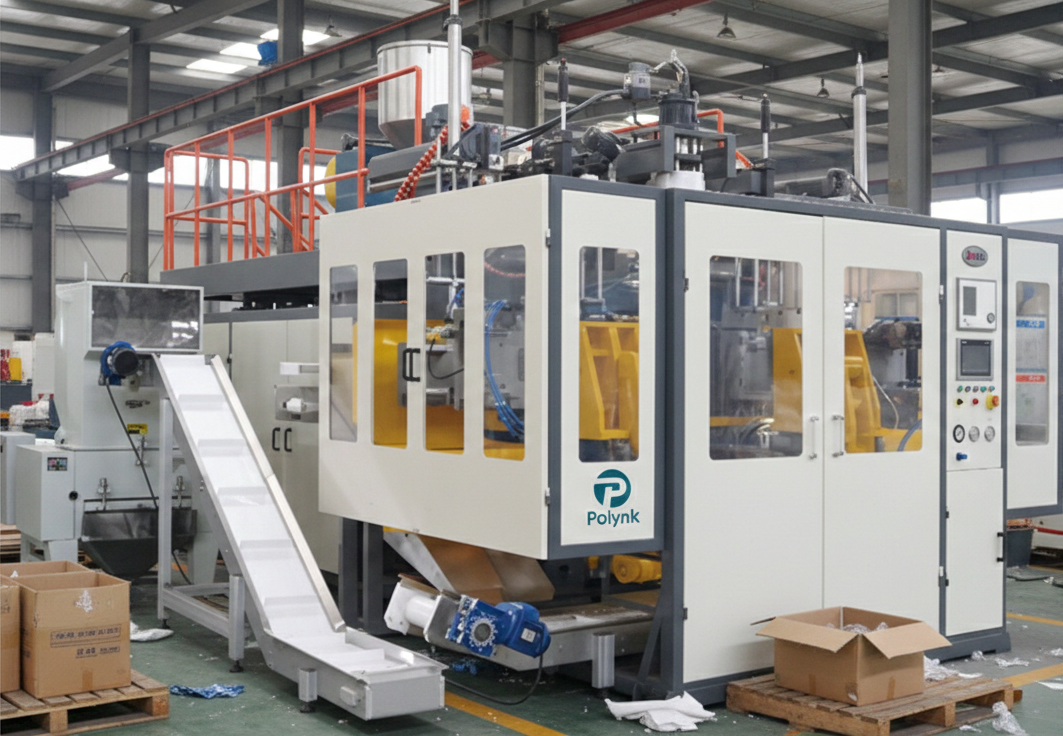
Plastic bottles are essential packaging solutions in multiple industries today. From beverages and dairy products to household chemicals and personal care items, PET and HDPE bottles dominate the market. Manufacturers often face a critical decision: can a single blow molding machine or extrusion blow molding machine handle both materials efficiently? Understanding how these machines work and their compatibility with different plastics is vital for optimizing production, reducing waste, and maintaining consistent quality.
This article explains the working process of blow molding machines, compares production for PET and HDPE bottles, and highlights the advantages of modern systems capable of handling multiple materials.
How Blow Molding Machines Work
Blow molding machines create hollow plastic products by converting molten thermoplastic into shaped containers using controlled air pressure and molds. The process includes several key stages:
Feeding and Melting
Plastic resin granules, either PET or HDPE, are loaded into a hopper and fed into the barrel of the machine. The barrel contains a rotating screw that pushes the material forward while friction and heating zones soften it into a molten state.
Modern machines use computer operating systems to control heating zones accurately. This ensures uniform melting and reduces material degradation, which is critical for both PET and HDPE bottles.
Parison or Preform Formation
The molten plastic is shaped into a tube called a parison or preform. In extrusion blow molding machines, the parison is extruded continuously, whereas in injection blow molding, a preform is created first and then transferred to the mold.
The parison thickness must be consistent, as uneven walls can lead to weak spots in bottles. Automated systems monitor parison dimensions in real time and adjust flow rates or screw speed accordingly.
Mold Inflation and Shaping
The parison or preform is enclosed within a mold. Compressed air inflates the plastic against the mold walls, forming the desired bottle shape. Maintaining the correct air pressure is essential: too low causes thin walls, and too high can over-stretch or deform the bottle.
Advanced blow molding systems allow manufacturers to set different pressure profiles depending on whether PET or HDPE is being processed.
Cooling and Solidification
After inflation, the bottle remains in the mold while cooling channels remove heat. Cooling time and water flow are critical: PET cools faster than HDPE, which requires longer cooling to prevent warping or shrinkage.
Both materials solidify uniformly in contemporary extrusion blow molding machines thanks to computer-controlled cooling.
Cutting and Finishing
Once cooled, bottles are removed from the mold. Excess material is trimmed, and bottles are inspected for wall thickness, weight, and surface quality. Some systems include automatic marking or packaging units for high-volume production.
Production Differences Between PET and HDPE Bottles
PET and HDPE have different material qualities, which impacts production factors, even if the blow molding technique is comparable overall.
PET Bottle Production
-
Requires precise heating to prevent degradation
-
High air pressure needed to maintain wall thickness
-
Faster cooling due to higher thermal conductivity
-
Primarily used for beverages and clear packaging
HDPE Bottle Production
-
Higher melting temperature than PET
-
Slightly more flexible material; may require slower mold inflation
-
Longer cooling time for dimensional stability
-
Used for milk, detergents, chemicals, and opaque packaging
Comparison Table: PET vs HDPE Bottle Production
| Aspect | PET Bottles | HDPE Bottles |
|---|---|---|
| Melting Temperature | Moderate (≈260°C) | Higher (≈280°C) |
| Flexibility | Less flexible, brittle if overheated | Flexible, resistant to cracking |
| Cooling Time | Fast due to thermal conductivity | Slower, requires controlled cooling |
| Air Pressure Requirement | High pressure to prevent thin walls | Moderate pressure, adjust to flexibility |
| Surface Finish | Transparent and smooth | Typically opaque, can be textured |
| Wall Thickness Uniformity | Critical, requires real-time monitoring | Important, flexibility allows minor variation |
| Machine Adjustment | Preprogrammed PET profile in computer control | Preprogrammed HDPE profile; minor adjustments needed |
| Industrial Application | Beverages, carbonated drinks, water bottles | Dairy, chemicals, household detergents, personal care |
This table highlights why modern blow molding systems are designed with versatility in mind, allowing the same machine to handle both materials efficiently.
Advantages of Using Blow Molding Machines for Both PET and HDPE
Using a single versatile blow molding machine offers several industrial advantages:
Cost Efficiency
Investing in one machine reduces capital expenditure. Factories can produce multiple bottle types without purchasing separate equipment.
Production Flexibility
A modern extrusion blow molding machine can switch between PET and HDPE production with minimal downtime. Automated temperature profiles and air pressure settings allow quick adaptation.
Consistent Product Quality
Advanced computer-controlled systems maintain wall thickness, diameter, and surface finish across long production runs for both materials.
High Production Capacity
Continuous extrusion systems support high-speed production. This enables manufacturers to meet large-volume orders efficiently, whether for PET or HDPE bottles.
Reduced Waste
Real-time monitoring of temperature, air pressure, and parison thickness reduces material wastage, a significant advantage when switching between different plastics.
Applications Across Multiple Industries
Beverage Industry: PET bottles for soft drinks, water, and juices
Dairy Industry: HDPE bottles for milk and cream
Chemical Industry: HDPE bottles for cleaning solutions and detergents
Personal Care Products: Both PET and HDPE for shampoos, lotions, and cosmetic containers
The ability to produce bottles in both materials allows a single production line to serve multiple sectors efficiently.
Factors to Consider When Using a Single Machine
-
Die and Mold Design: Dies may need slight modification for different material viscosities.
-
Temperature Profiles: Machines must have programmable heating zones for PET and HDPE.
-
Cooling Systems: Adjustable cooling time and water flow prevent warping and deformation.
-
Operator Training: Technicians must understand material differences to adjust parameters correctly.
Modern blow molding systems equipped with computer operating systems simplify these adjustments, ensuring smooth transitions between PET and HDPE production.
Conclusion
Modern blow molding machines and extrusion blow molding machines are indeed suitable for producing both PET and HDPE bottles. With computer-controlled heating, pressure, and cooling systems, manufacturers can switch between materials efficiently while maintaining consistent quality and reducing waste.
Investing in versatile blow molding systems allows factories to serve multiple industries from beverages and dairy to chemicals and personal care without needing separate equipment for each material. Understanding material properties, process requirements, and machine capabilities is essential for achieving stable production, high efficiency, and long-term operational success.
By leveraging advanced blow molding systems, manufacturers can meet market demand for both PET and HDPE bottles while minimizing downtime, improving productivity, and ensuring reliable, high-quality output.
Visit for news and updates at mypremiumcollection.com