


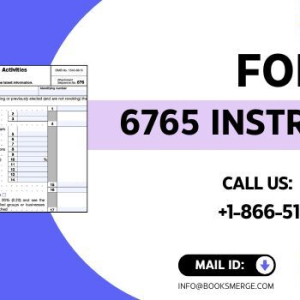

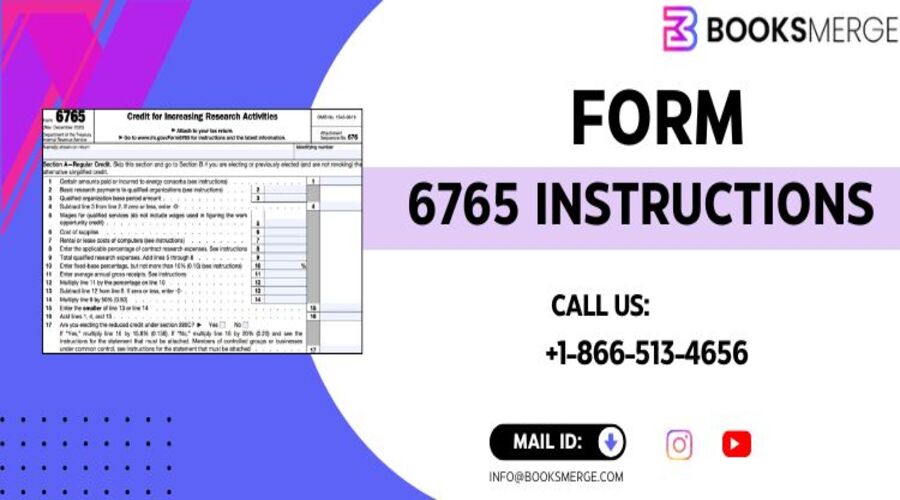
Form 6765 Instructions explain how to complete the IRS R&D tax credit form, what expenses qualify, how to calculate credit, and documentation needed to claim the credit correctly.
When you hear Form 6765 Instructions, think of a map that shows you how to claim the credit for increasing research activities with the IRS without pulling your hair out. If you are an innovator, startup founder, CPA or finance manager, this guide breaks down real IRS guidance into simple terms, logical steps, and practical tips that actually help.
At BooksMerge, we believe in simplifying tax complexity while building your tax trust. If you need professional help with research credit filing, call +1‑866‑513‑4656 — let us navigate the details for you.
Table of Contents
-
Why IRS Form 6765 Matters?
-
What is Form 6765 Used For?
-
Key Definitions You Must Know
-
Step‑by‑Step: How to Complete Form 6765
-
What Changed in 2025 and Beyond?
-
Who Qualifies for R&D Tax Credit?
-
Qualified Research Expenses (QREs) Explained
-
ASC vs Regular Method Calculation
-
Payroll Tax Credit Election: Startups & Small Business
-
Required Documentation Checklist
-
Common Mistakes to Avoid
-
Conclusion
-
FAQ
1. Why IRS Form 6765 Matters?
Form 6765 is the IRS’s official way for businesses to claim a federal research and development (R&D) tax credit that reduces your tax bill when you spend money on qualifying research activities.
This credit can mean real cash savings at tax time — not just paper benefits — especially if you are a qualified small business electing payroll tax offset.
2. What is Form 6765 Used For?
In plain terms, Form 6765 lets you:
-
Figure and claim the R&D tax credit
-
Elect a reduced credit under section 280C
-
Apply credit against payroll taxes (up to $500,000) if eligible.
The credit for increasing research activities is sometimes called the R&D tax credit.
3. Key Definitions You Must Know
Before diving into lines and numbers, these terms are essentials:
-
QREs (Qualified Research Expenses) – Costs eligible for the research credit.
-
Section 280C election – Option that affects whether you reduce your credit or keep full deductions.
-
Alternative Simplified Credit (ASC) – A simpler credit calculation method.
-
Qualified small business – Business eligible to apply credit against payroll taxes.
4. Step‑by‑Step: How to Complete Form 6765
The IRS separates instructions into clear sections: A, B, C, D, E, F and, starting in 2026, G. Here’s how the flow works:
Section A – Regular Credit
-
Enter energy and basic research expenditures
-
Report total QREs
-
Compute fixed‑base percentage (varies for startups)
-
Figure out your credit
Section B – Alternative Simplified Credit (ASC)
If you choose ASC instead of regular method, you:
-
Enter current and prior QREs
-
Follow simplified percentage steps to figure credit.
Section C – Current Year Credit
This is where the computed credit lands. You must allocate it correctly across lines.
Section D – Payroll Tax Credit Election
If you want to apply the credit against payroll taxes, complete Section D and attach Form 8974 to your employment tax return.
Sections E & F – Other Information and QRE Summary
Section E is additional detail; Section F is a summary of all QREs you reported in other parts.
5. What Changed in 2025 and Beyond?
IRS Form 6765 instructions were updated in late 2025 with several important changes:
-
Section G (Business Component Information) will be optional in 2025 for all filers but mandatory in 2026, subject to certain criteria.
-
Extended transition period gives time to perfect claims through early 2027 for amended refunds.
-
Ongoing IRS feedback period may further refine instruction language as part of taxpayer outreach.
Curious about What new information must be reported on IRS Form 6765 beginning in 2026? Keep an eye on IRS official guidance since Section G business component reporting will be complex and detailed.
6. Who Qualifies for R&D Tax Credit?
Eligibility depends on the nature of your business and your activities. Typically:
-
Companies spending on innovation, product development, prototypes, engineering and technical tasks
-
Qualified activities exclude routine maintenance or cosmetic changes.
Your CPA will determine if your activities meet the IRS’s four‑part test for R&D; details are in the IRS instructions.
7. Qualified Research Expenses (QREs) Explained
QREs are the backbone of the credit and include:
-
Wages of employees performing qualified research
-
Supplies used in R&D work
-
Rental or lease of computers used for research
-
Contract research expenses when paid to others.
For a deeper dive into business financial choices around R&D and small business strategy, check out this article on Financial Literacy Statistics.
8. ASC vs Regular Method Calculation
There are two basic ways to calculate your research credit:
-
Regular Method – Requires historical data to determine fixed‑base percentages.
-
Alternative Simplified Credit (ASC) – Simpler and often easier for early‑stage companies.
Both yield the same goal — a tax credit — but ASC avoids some of the complicated base period math. Your choice should be strategic.
9. Payroll Tax Credit Election: Startups & Small Business
A big reason startups and small businesses love Form 6765: you can elect to use your R&D credit against payroll taxes (up to $500,000).
This is especially valuable for early‑stage companies with little profit but significant payroll costs since you get cash relief instead of waiting for income tax liability.
10. Required Documentation Checklist
To support your credit claim and defend an audit, keep:
-
Detailed payroll records showing qualified wages
-
Logs of research activities and expenses
-
Calculations of QREs broken down by category
-
Attachments for controlled groups if applicable
-
Evidence supporting your chosen method (ASC or regular)
Good documentation can make the difference between an accepted credit and a denied refund.
11. Common Mistakes to Avoid
Avoid trouble by:
-
Missing documentation for QREs
-
Forgetting to attach Form 8974 for payroll credit
-
Misreporting business components
-
Not checking the right boxes for elections
Precision reduces audits and improves your tax outcome.
12. Conclusion
The IRS Form 6765 instructions are detailed but manageable with the right approach. They help businesses claim important federal research credits, elect payroll offsets, and plan future R&D spending. Real IRS guidance, structured steps, and clear documentation are your best tools.
At BooksMerge, our team makes tax filing easier. For expert support with Form 6765 or any other tax matter, reach us at +1‑866‑513‑4656.
Frequently Asked Questions (FAQ)
1. What is Form 6765 used for?
Form 6765 is used to figure and claim the federal R&D tax credit and to elect options like payroll tax offset and reduced credit under section 280C.
2. Who qualifies for R&D tax credit?
Companies spending on qualified research activities like product development, technical innovation, or experimental processes.
3. What are QREs?
Qualified Research Expenses include wages, supplies, contract research costs and certain computer resources used for research.
4. How to calculate ASC vs regular method?
The regular method uses historical base periods and percentages; ASC simplifies calculation based on recent year QREs.
5. What documents are required?
Payroll reports, research logs, expense breakdowns, attachments for group reporting, and records of method election.
6. Can startups use payroll offset?
Yes, qualified small businesses can elect to apply R&D credit against payroll taxes, up to $500,000.
7. What changed in 2025?
Key updates include optional Section G reporting in 2025 and extended transition periods for amended claims.
8. How is Form 6765 calculated?
Credit is a percentage of QREs using either ASC or the regular base period method, as instructed by the IRS.